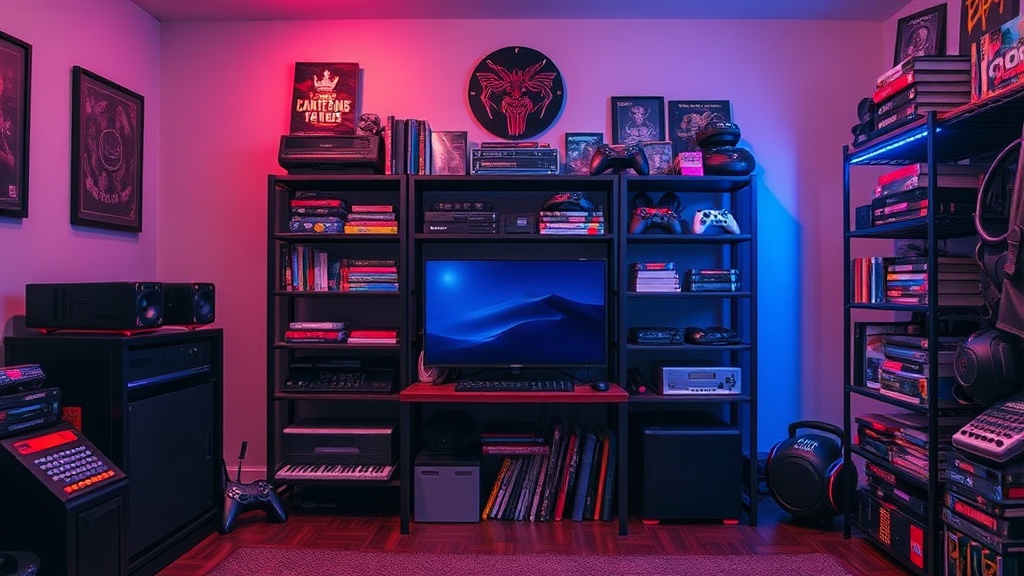
Where Should You Store Gaming Collectibles When You're Running Out of Room?

Your collection has outgrown its dedicated shelf. Boxes are stacking in closets, figures crowd your desk, and you've started eyeing that space under the bed with desperate speculation. This post walks through practical storage strategies for gaming collectibles that won't damage your items or dominate your living space. Whether you rent a studio apartment or own a home with a basement, you'll find solutions that protect your investment without turning your space into a warehouse.
Should You Store Collectibles Vertically or Horizontally?
The orientation of your storage matters more than most collectors realize. Figures and statues stored horizontally often experience uneven pressure distribution—gravity pulls differently when an item lays on its side versus standing upright. For resin statues and articulated figures, vertical storage typically reduces long-term deformation risks. The weight distributes along the structural supports designed by manufacturers rather than creating new stress points.
Vertical storage also maximizes cubic footage more efficiently than horizontal arrangements. A standard Billy bookcase from IKEA stands 79.5 inches tall and costs under $100, providing roughly 21 cubic feet of enclosed storage. The same footprint used horizontally would consume significantly more floor space for equivalent volume. For renters or anyone in urban housing, vertical thinking isn't just smart—it's necessary.
That said, some items genuinely prefer horizontal storage. Strategy board games with mounted boards, certain vinyl record-style gaming soundtracks, and delicate papercraft models often travel better flat. The key is matching the orientation to the item's structural integrity and intended use frequency. Items you access monthly can afford more protective horizontal storage; daily drivers need vertical accessibility.
What's the Best Way to Use Climate-Controlled Storage Units?
External storage units tempt many collectors facing space constraints, but gaming collectibles require specific environmental conditions that standard units rarely provide. Temperature fluctuations cause plastic expansion and contraction—PVC figures can develop stress cracks after repeated cycles. Humidity above 50% invites mold growth on cardboard packaging and can corrode metal pins in trading card displays. The National Park Service conservation guidelines recommend stable environments between 65-72°F with 35-45% relative humidity for mixed material collections.
Climate-controlled units cost 25-50% more than standard storage, but they're non-negotiable for valuable collections. When evaluating facilities, ask about humidity monitoring—not just temperature control. Some facilities maintain temperature while ignoring moisture levels, creating environments where condensation forms inside sealed display cases. Visit prospective units at different times of day; morning humidity often differs dramatically from afternoon conditions.
Organization within storage units demands systematic thinking. Place heaviest items on bottom shelves—not because of structural risk (most shelving handles weight fine), but because lifting heavy collectibles overhead invites accidents. Create aisle space even in small units. You should be able to access any box without moving more than two other containers. Label every side of every box, not just the top. Units get rearranged, and "top" becomes relative when you're stacking efficiently.
How Do You Protect Collectibles in Humid Climates Without a Dedicated Room?
Not everyone has a basement, spare bedroom, or climate-controlled unit available. Apartment dwellers in humid regions face particular challenges—Houston summers, Florida year-round, Pacific Northwest winters all threaten cardboard and metal components. The solution isn't single-point interventions but layered moisture management.
Start with desiccant placement that actually works. Those tiny silica packets included with figures are consumed during shipping—they're spent before you open the box. Replace them with indicating silica gel canisters that change color when saturated. These cost roughly $15-25 for sets of ten and can be recharged in an oven when saturated. Place them inside sealed containers rather than open shelves—passive humidity control in open air is mathematically futile.
Consider closed storage systems with active moisture barriers. Detolf cases from IKEA, popular among collectors for good reason, can be modified with weatherstripping tape around door edges. Add rechargeable dehumidifiers (the wireless kind with indicator windows) inside each case. This creates micro-environments with 15-20% lower humidity than ambient room conditions. For high-value collections, the IICRC standards for water damage prevention emphasize that controlling relative humidity prevents 80% of material degradation issues.
Air circulation matters even in closed systems. Stagnant air pockets develop humidity gradients—corners and lower shelves become microclimates with condensation risks. Small USB-powered fans, the kind sold for cooling electronics, positioned at case bottoms create gentle convection currents. These cost under $10 and prevent the stillness that lets moisture accumulate.
Can You Store Gaming Collectibles in Original Packaging Long-Term?
The "to open or not to open" debate extends into storage methodology. Mint-in-box collectors face unique spatial challenges—packaging designed for retail display rarely optimizes for density. A Nintendo Amiibo in blister pack consumes roughly 12 cubic inches; the same figure loose needs under 3 cubic inches. Multiply that difference across a hundred figures and you're looking at significant spatial math.
Original packaging serves genuine protective functions beyond collectibility. Cardboard backing absorbs impact forces, blister plastic prevents surface contact with other items, and factory foam inserts cradle delicate paint applications. However, packaging materials age differently than the collectibles they protect. Acidic cardboard (common in older gaming merchandise) yellows and becomes brittle. PVC window film on boxes can off-gas plasticizers that actually damage figures over decades.
For long-term boxed storage, the archival approach matters. Never store boxes directly on concrete floors—concrete wicks moisture and transfers alkalinity. Use wire shelving that permits airflow beneath boxes, or place corrugated cardboard sheets as barriers. Avoid stacking boxed figures more than three high; lower boxes compress and crease, upper boxes risk crushing. If you're keeping original packaging for potential resale, photograph each box before storage—documentation matters if damage occurs during moving or environmental events.
What About Creative Solutions for Really Tight Spaces?
Sometimes standard shelving fails the space equation. Studio apartments, shared housing, and collector-partnered relationships (where not everyone shares your enthusiasm) demand creative approaches. Under-bed storage containers with locking lids protect against dust and casual damage while reclaiming 20-30 cubic feet of typically wasted space. Choose containers with flat lids rather than domed ones—they stack if needed and slide smoothly.
Vertical space above doorways remains dramatically underutilized. Custom shelves installed above standard door frames (typically 80 inches high) provide 8-12 inches of depth perfect for boxed figures or display cases. This space is visually unobtrusive—you don't look up when entering rooms—and keeps collectibles away from traffic patterns where accidents happen. Installation requires finding studs and using proper anchors, but the spatial gain justifies the effort.
Furniture multi-tasking offers another avenue. Ottomans with internal storage, hollow coffee tables with lift-tops, and platform beds with drawer systems all provide concealed capacity. The trade-off is accessibility—you won't rotate displays frequently from under-bed storage—but for backup collections or seasonal rotation pieces, concealment beats clutter. The Smithsonian Museum Conservation Institute guidelines note that protected storage (even if less accessible) often outperforms convenient but risky display for preservation purposes.
The Psychological Dimension of Collector Storage
Beyond physical preservation, storage arrangements affect how you interact with your collection. Items buried in opaque bins get forgotten. Collections stored across multiple locations (some at parent's house, some in storage unit, some displayed) fragment your mental inventory. The best storage system isn't merely protective—it's transparent enough that you remember what you own.
Consider implementing a digital inventory alongside physical organization. Photograph items as you store them; maintain a spreadsheet with location codes ("Shelf B3", "Under-bed Bin 2"). This sounds obsessive until you're hunting for that one specific Amiibo at 11 PM, convinced you own it but unable to locate it. The search anxiety isn't trivial—collecting should bring satisfaction, not frustration.
Rotation systems help too. Store 70% of your collection, display 30%, and swap quarterly. This keeps your space feeling fresh without requiring additional square footage, and it protects items from the cumulative light damage that constant display invites. Your collection stays dynamic while remaining physically manageable.